
When I was researching the topic for my latest course, Theme Writing 4: Associations of Melody, at first I thought there would be little to explore with the idea of a theme’s melodic opening being associated with certain expressions. I mean, we all know a couple of these off hand, like the rising perfect 5th in major keys for the heroic, as in John Williams’ Star Wars or Superman main theme. Or the rising major 6th up to the 3rd degree of major keys for many of the same composer’s love themes. But I never thought there was anything more than that – until I started looking for others.
And I was surprised to find so many of them! Not just for the heroic and love, but many more like childhood, pleasant, hardship, evil, the ancient, and the list goes on. Once the evidence started to pile up, I thought this actually makes a lot of sense. Themes in films and television are usually presented in abbreviated form with only their first four bars or even two bars of an 8-bar theme being sounded. With so little space in most of a theme’s statements, it makes sense to pack meaning into the theme’s first few notes.
One of the ways that this meaning is conveyed so quickly is through what I call melodic gestures, which are combinations of scale degrees from a major or minor scale that often have an association in film and television music. And often, composers will use two or three gestures to communicate several of a character’s traits in the first four bars, or even the opening two-bar span, or what is called the theme’s basic idea.
Melodic Gestures
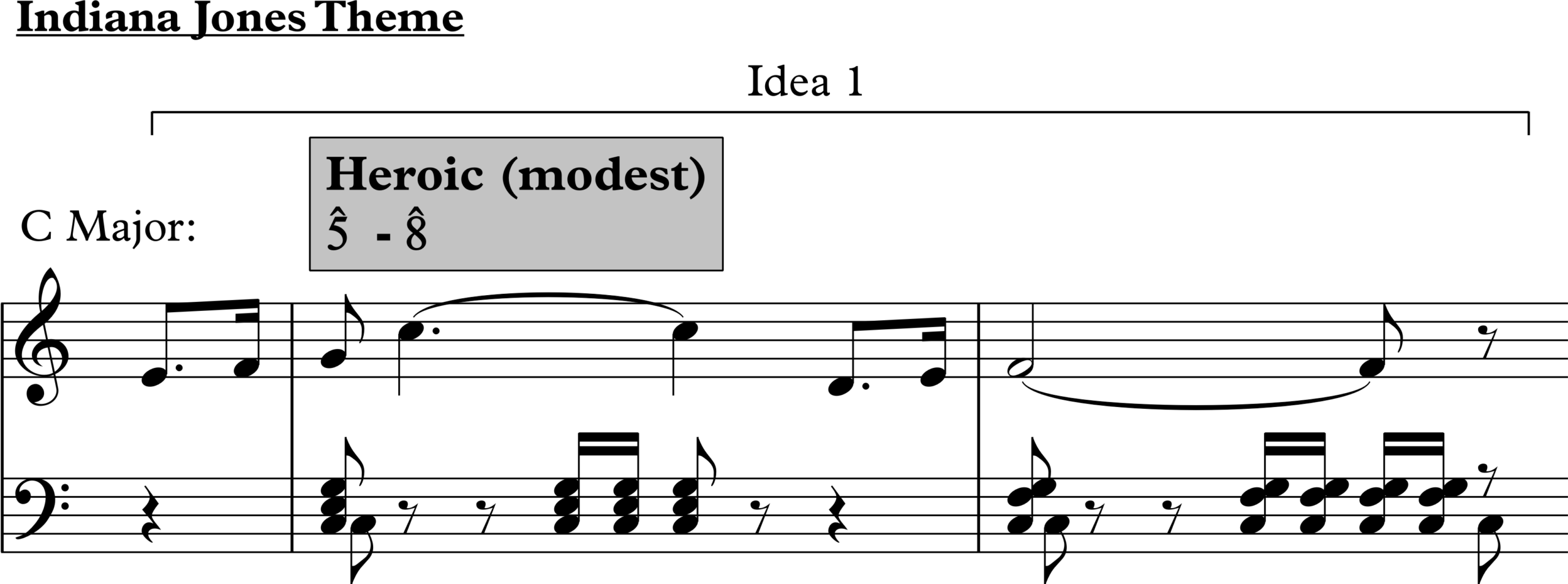
The leap of a 4th from degree 5 up to 8 can signal the heroic in either a major or minor key. Probably the most familiar example is the opening of John Williams’ theme for Indiana Jones, which is in a major key (example below). This kind of heroic gesture is not the leap of a 5th like in the themes for Star Wars or Superman, but the smaller 4th, and appropriately, the gesture of a 4th generally accompanies heroes of a more human or modest sort, like Indy himself.
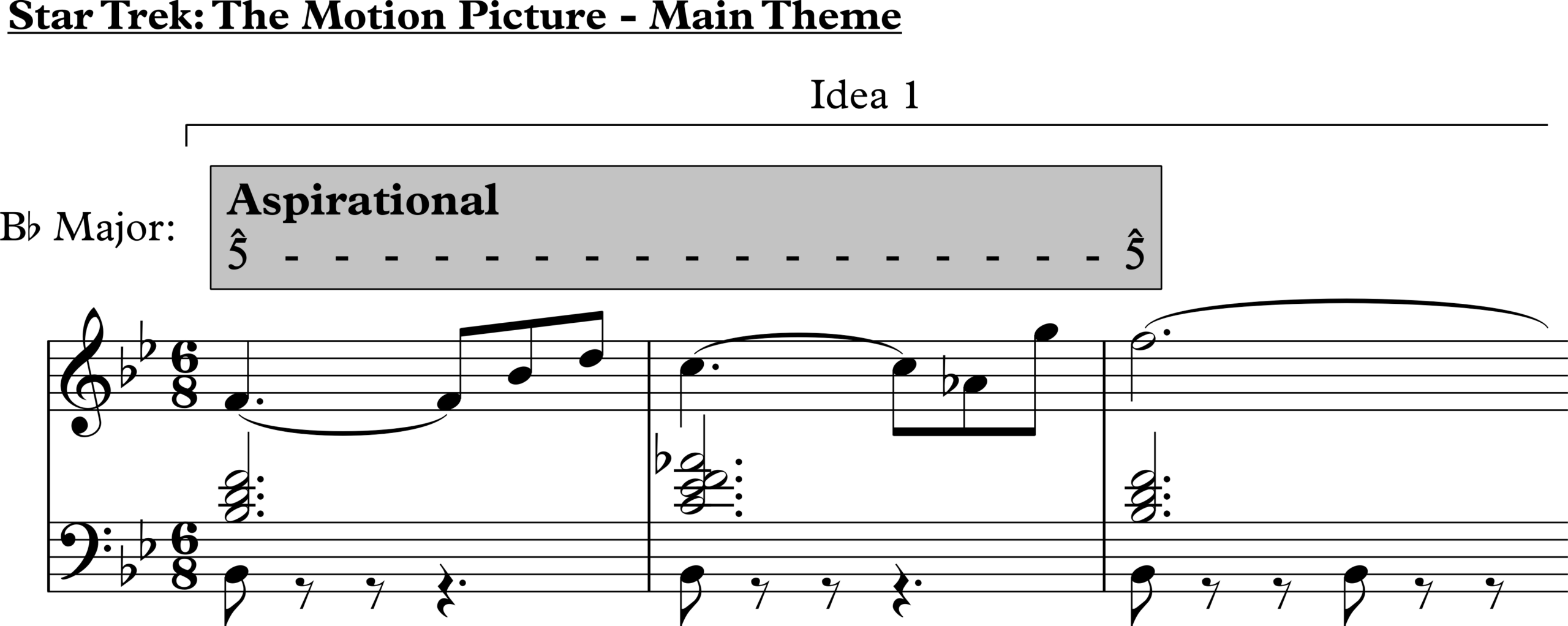
Gestures can also have extra notes inserted in between, and usually the gesture still comes across because its notes are the first and last of the figure. Take the opening of Jerry Goldsmith’s theme to Star Trek: The Motion Picture (example below). Over the first few bars, the major-key theme goes from F to the F an octave higher. This is a gesture often associated with the aspirational, as though metaphorically reaching for something higher and that takes a real effort to achieve.
Gestures in a Theme from How to Train Your Dragon
When a character or other association is particularly multi-faceted, composers often write more than gesture into a theme’s opening. Consider John Powell’s score to the original How to Train Your Dragon (2010), specifically the basic idea of his theme for the aspirations of the Vikings, which are often put into action by the main character, the teenage boy Hiccup (example below). This theme starts with a rise through the tonic chord of G major, from scale degree 5 up to the 5 an octave higher. As we saw with Star Trek, this octave rise on the 5 degree (with intervening notes) suggests the aspirational. And the gesture itself makes sense: the rise up the octave symbolizes the desire to reach a higher level of accomplishment. At first, Hiccup aspires to be like the adults of his Viking clan, and later aspires to inform his people of the truth that the dragons are not their enemies, so the expression is a very appropriate one.
After this octave rise on D, Powell continues rising to the tonic G above. He does include an F# which is not part of the gesture. But this is a mere decoration to the more important D–G motion, which is the 5–8 leap of a 4th that suggests the heroic of a more modest character, as we saw with the Indiana Jones theme. And Hiccup is definitely a modest hero, even to the point of being self-deprecating. The fact that the gesture is decorated disguises the gesture somewhat, a beautifully musical way of suggesting that Hiccup’s heroism is something that is not immediately apparent but comes through in the end, which is of course what happens with Hiccup over the course of the film. The theme’s second idea even reiterates this 5–8 gesture with an intervening G down an octave before coming to a half close. On top of all this, the theme outlines a larger-scale 5–6–5 motion with D–E–D, a gesture often associated with the noble or pure, which certainly describes Hiccup’s motives throughout the story:
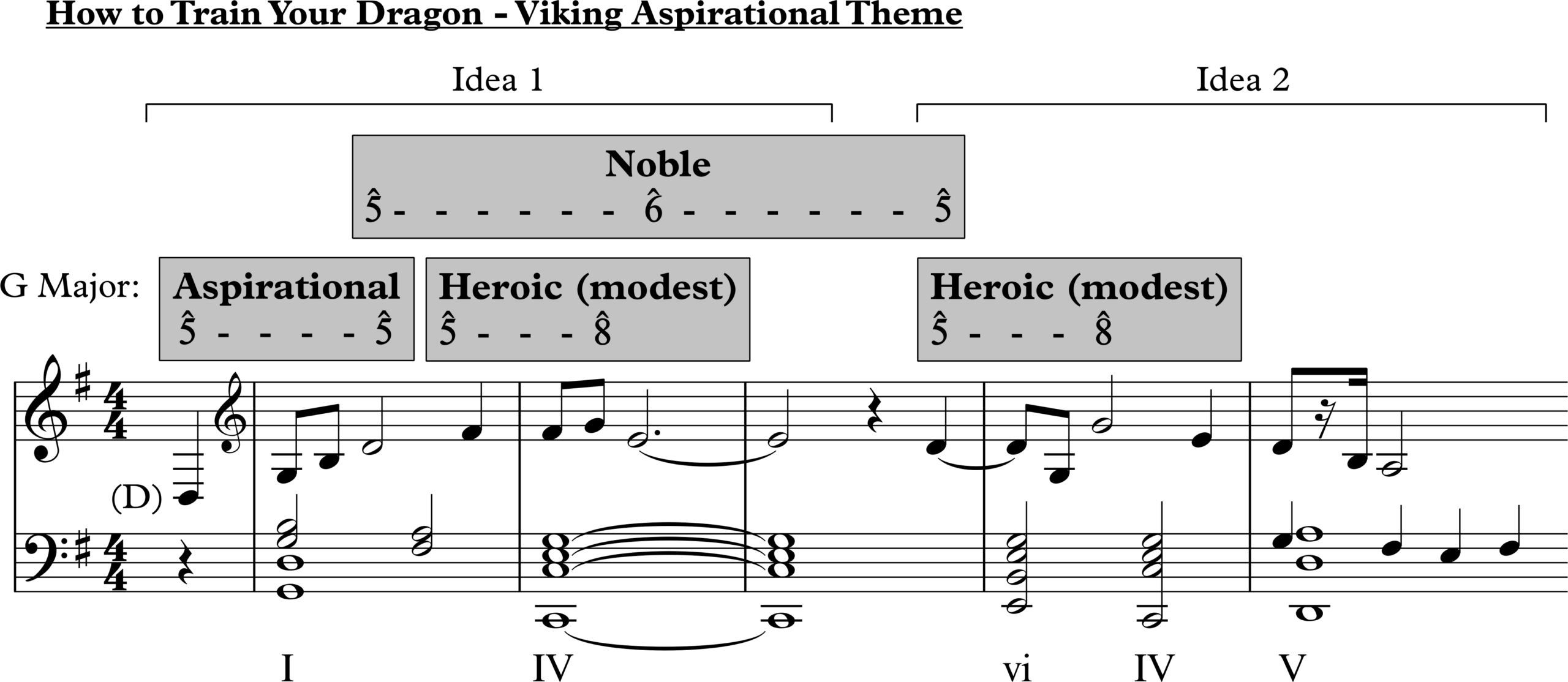
These three gestures together – aspirational, heroic, and noble – create a wonderfully detailed outline of Hiccup’s personality. No doubt, this connection plays a large part in why this theme feels so effective for the character, no matter if it’s used in manner that’s playful, sympathetic, or action-packed. The gestures always give us an emotional expression of the character’s personality, and that helps us to relate to the character on a subconscious level and in any situation. Hiccup is a very likable character, and the theme, with its clever use of three different gestures, constantly reminds us why.
It was these kinds of discoveries that led to me to believe that these melodic gestures are a valuable and extremely powerful part of film music, and certainly a good topic for Theme Writing 4!